

Occupational Health Explained: A simple guide to building a healthier, more productive workforce

From preventing sickness absence to retaining valuable talent, occupational health has become an essential part of building a healthy workforce.

If you’ve never used occupational health before, you’re not alone. Just 52% of UK employees have access to occupational health, despite evidence showing that early intervention can prevent sickness absence in almost two-thirds of cases.

Many employers still associate occupational health with long-term sickness absence. However, it can also help employers identify health risks, support employees with health conditions and, crucially, prevent avoidable sickness absence before it becomes long term.

This guide explains what occupational health is, when employers should use it and how it can help businesses of every size.

What is Occupational Health?

Occupational health helps employers protect the health of their workforce by combining expert advice, workplace support and specialist health services to help employees stay healthy, recover from illness and remain in work.

At a time when many employees face long waits for NHS treatment, occupational health can provide timely access to physical and mental health support, while advising managers on practical ways to help employees stay in work while they recover.

It can also help people manage long-term health conditions, improve their health and reduce future health risks through individualised advice and proactive wellbeing education.

For employers, it can help identify workplace health risks and meet their legal duty to protect employees from health issues related to their place of employment.

Occupational health can help employers:

Prevent sickness absence through early intervention, health screening, wellbeing initiatives and proactive support to help employees stay healthy.

Access care through timely access to physiotherapy, counselling and other physical and mental health services, helping employees recover more quickly and reduce time away from work.

Sustain work by supporting employees to manage health conditions while advising managers on practical workplace adjustments that help people remain in work.

Identify risk with workplace risk assessments and health surveillance, helping employers meet their legal duty to protect employees from work-related health risks.

When should employers use Occupational Health?

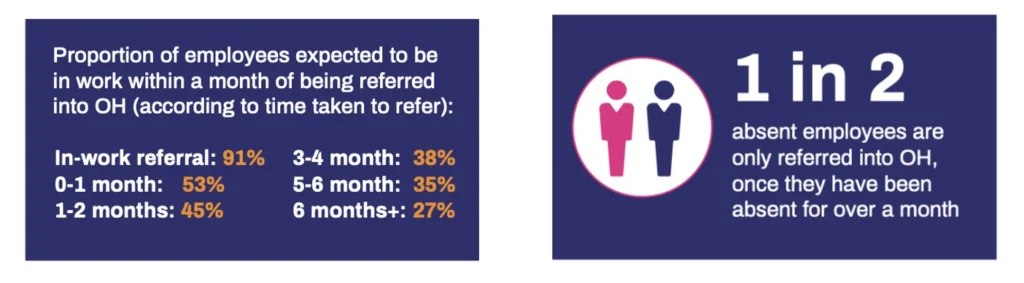
The earlier, the better. Analysis of more than 1,300 occupational health referrals by PAM Group found that referring employees while they were still in work prevented sickness absence in almost two-thirds of cases. Yet one in two managers wait until an employee has gone off sick before seeking occupational health support.

There is a direct correlation between when employees are referred into occupational health and the likelihood of them remaining in work. 91% of employees referred while they were still in work were expected to remain in work one month later, compared with just 45% of those referred after one to two months of absence and 27% of those who had been off work for more than six months.

Occupational health isn’t just for supporting employees who already struggling. Employers also use it provide access to voluntary health checks and wellbeing initiatives for early identification and lifestyle changes.

For example, engineering firm EKFB encouraged employees to have a voluntary health check to find out their cholesterol and blood pressure and think of ‘one small change’ they could make to improve this. The results ranged from supporting employees to batch cook to challenge the idea that healthy food needs to be cooked from scratch every night, to increasing the opportunities for social connections to boost mental health.

Health surveillance and health assessments for safety critical work provides an opportunity for advice on general healthealth surveillance can help to identify ill health caused by work, so controls can be improved to prevent long-term health conditions.

How can you make the business case for occupational health?

Healthy employees are more productive, more engaged and less likely to leave. Our latest nationwide Health at Work Report found that employees who receive proactive support to stay healthy are:

  • Twice as likely to take no sickness absence
  • Eight times more likely to feel very or highly productive
  • Twenty times less likely to want to work elsewhere 

If you’re introducing occupational health for the first time, you don’t have to transform your whole approach overnight. Many employers begin by referring employees who need support while they’re still in work, then use absence, productivity and employee engagement data to evaluate the impact before expanding their occupational health provision.

The key is to measure the outcomes that matter to your business. Rather than looking at occupational health in isolation, think about linking workforce health to business metrics you already track, such as sickness absence, productivity, employee engagement and staff retention. This helps demonstrate the return on investment and identify where additional support can make the biggest difference.

An occupational health provider can also carry out a ‘needs assessment’ to advise on your statutory requirements as well as what would benefit the health of your workforce within your budget.

Janet O’Neill is head of occupational health training for PAM Group

How can PAM Group help?

Whether you’re looking to introduce occupational health for the first time or get more from your existing service, PAM Group’s connected health model helps employers to:

  • Prevent sickness absence through early intervention and proactive health support.
  • Access care through timely physical and mental health services.
  • Sustain work by helping employees stay in or return to work safely.
  • Identify risk through workplace health assessments and health surveillance.

To find out how PAM Group can support your organisation, visit pamgroup.co.uk or arrange a free callback with one of our consultants. Contact us today

Recent Insights

SUBSCRIBE

Occupational health insights on keeping your people healthy and productive

Want to have our latest research, case studies and opinions
delivered straight to your inbox?

About us
Scroll to Top