


How to create a menopause action plan

Employers will soon be legally required to support employees through menopause, from training managers to offering workplace adjustments.

With 1 in 10 women who worked during menopause saying they had to leave their job due to symptoms, new legislation planned for next spring will require employers to do more.

Employers with 250 or more employees will be required to publish an Equality Action Plan setting out how they are supporting employees experiencing menopause.

Critical to implementing an effective plan is not just acting across six recommended areas but doing so in a way that genuinely allows women to thrive at work.

Six actions to build a menopause action plan

The Government has identified six evidence-informed actions employers can choose from to support employees experiencing menopause, from training managers to reviewing policies and offering workplace adjustments.

Employers won’t be required to implement all six but will need to include at least one menopause action within their wider Equality Action Plan. Here, we look at each of the six recommended areas and how to make them meaningful in practice.

1. Train managers

A key recommendation is to train managers to recognise and support employees experiencing menopause. This matters because for many women symptoms start during perimenopause and aren’t always the hot flushes typically associated with menopause. Changes in concentration, memory, mood, sleep or energy can be harder to recognise, and many women may not realise themselves what is happening.

A woman who suddenly starts forgetting meetings, missing deadlines or struggling with a job she has previously done well may not ask for menopause support because she doesn’t know she needs it. She may simply feel she is no longer performing as she should and could even find herself being pulled into performance management. Managers can play a vital role in recognising that something else might be going on, opening up a conversation and putting practical support or adjustments in place.

But they need the knowledge and confidence to do this sensitively. Without it, discomfort around menopause can mean managers avoid the subject, dismiss symptoms or resort to humour that doesn’t land well. Training can help them recognise when someone might need support, start the conversation and know what they can do to help.

2. Offer occupational health advice

Every workplace and every woman’s experience of menopause is different, so it’s unsurprising that access to occupational health advice is one of the key areas the Government is encouraging employers to focus on. A confidential consultation with a clinician can help women explore barriers to their wellbeing and performance at their particular place of work and report back to managers on how best to support them.

This can be particularly helpful for symptoms women may feel embarrassed discussing with a manager. Someone experiencing urinary problems, for example, can talk openly to a clinician, while her manager only needs to know that she would benefit from more frequent comfort breaks.

A holistic OH provider can also signpost women into other services, from physiotherapy for musculoskeletal pain or frozen shoulder, and counselling for anxiety to neurodiversity support for women with conditions such as ADHD, who may find existing strategies for managing focus and organisation become less effective during menopause.

3. Set up support groups and networks

Another recommended action is to create menopause support groups or networks. This matters because menopause can be difficult to talk about at work, particularly for women who are worried about being perceived as less capable. Creating a menopause café, working group or peer support network gives people a more informal way to share experiences, learn what has helped others and feel less alone.

Consider opening these groups up to people supporting someone through menopause too, whether that’s a partner, mother, sister or colleague. Senior leaders can also make a real difference by talking openly about their own experiences and what helped them or their partner.

When people see others discussing menopause without embarrassment, it helps make those conversations feel normal and culturally acceptable across the organisation.

4. Offer workplace adjustments

Workplace adjustments are another area of focus. For some women, menopause symptoms can become so intense that they feel they can no longer cope at work, when relatively simple adjustments can help them continue in their role.

Brain fog, for example, can affect concentration and memory to the point that someone who has always performed well suddenly forgets an important meeting or misses a deadline. Practical tools and techniques to support memory and concentration, or temporarily reconfiguring aspects of their role, can help them manage this loss of function and rebuild their confidence. Meanwhile, cooler PPE or access to fans can help someone with hot flushes.

When planning adjustments, consider the different roles and working environments across your organisation. Someone working in an office will have very different adjustment requirements to someone working in retail, a hospital, with machinery or in a safety-critical role. The key is to understand what the individual is struggling with and identify practical changes that are operationally feasible to help them remain functioning well and in work.

5. Conduct a menopause risk assessment

The Government also recommends conducting a menopause risk assessment. When developing your menopause risk assessment, look at how common symptoms could affect employees across different roles and working environments.

Consider practical issues such as temperature and ventilation, access to cold drinking water and toilets, and whether employees experiencing fatigue may need more frequent breaks. Also think about less visible symptoms. Brain fog and poor concentration, for example, could have very different implications for someone working in a safety-critical role than for someone working at a desk.

The aim isn’t to assume that menopause creates a risk, but to identify where the workplace or role could exacerbate particular symptoms and take steps to reduce the impact on women’s wellbeing and ability to work.

6. Review policies and procedures

The final recommended action is to review your menopause policies and procedures. Whether introducing a menopause policy for the first time or updating an existing one, start by talking to employees about what would actually help them. Every workplace is different, so use their experiences to identify where existing policies or processes might need to change.

Consider the types of support that could help women remain well and in work. Then make sure the policy clearly explains what support is available, the role managers are expected to play and where employees can go for further help.

Keep the language accessible and talk directly to employees, rather than turning the policy into a lengthy HR document that nobody reads. For more information, read our quick guide on How to Write a Menopause Policy.

Kate Martin is head of psychological services for PAM Group

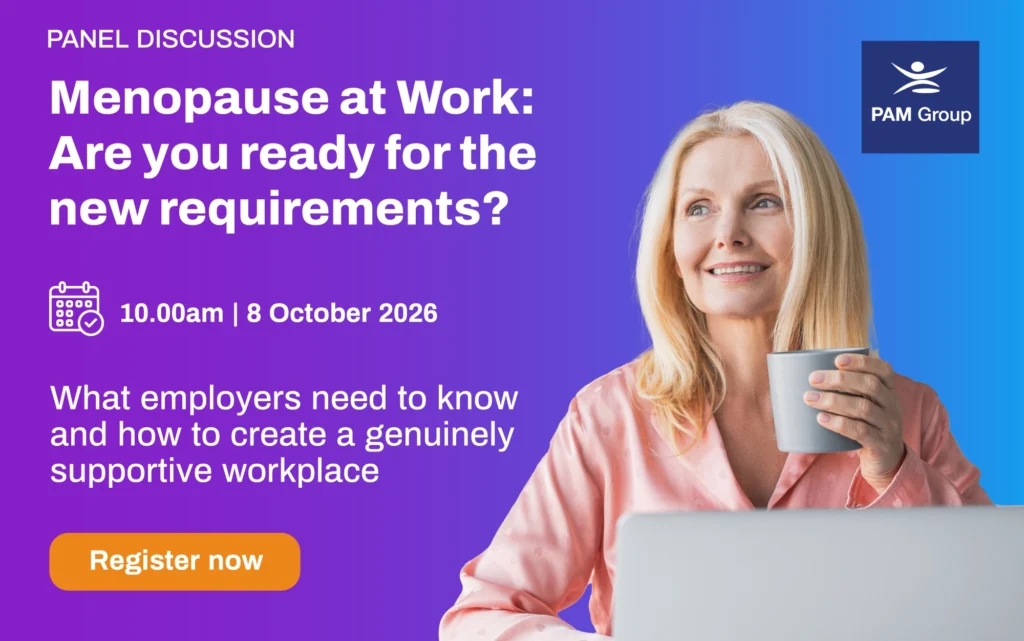
Menopause at Work: Are you ready for the new requirements? 10.00am, 8 October 2026

Is your organisation ready for the new menopause action plan requirements? Join our expert panel to understand what’s changing, what employers should be doing now to prepare and how to create a genuinely supportive workplace for women experiencing menopause.

If you would like support developing a menopause action plan tailored to your organisation, contact us to arrange a free consultation.

Recent Insights

SUBSCRIBE

Occupational health insights on keeping your people healthy and productive

Want to have our latest research, case studies and opinions
delivered straight to your inbox?

About us
Scroll to Top