
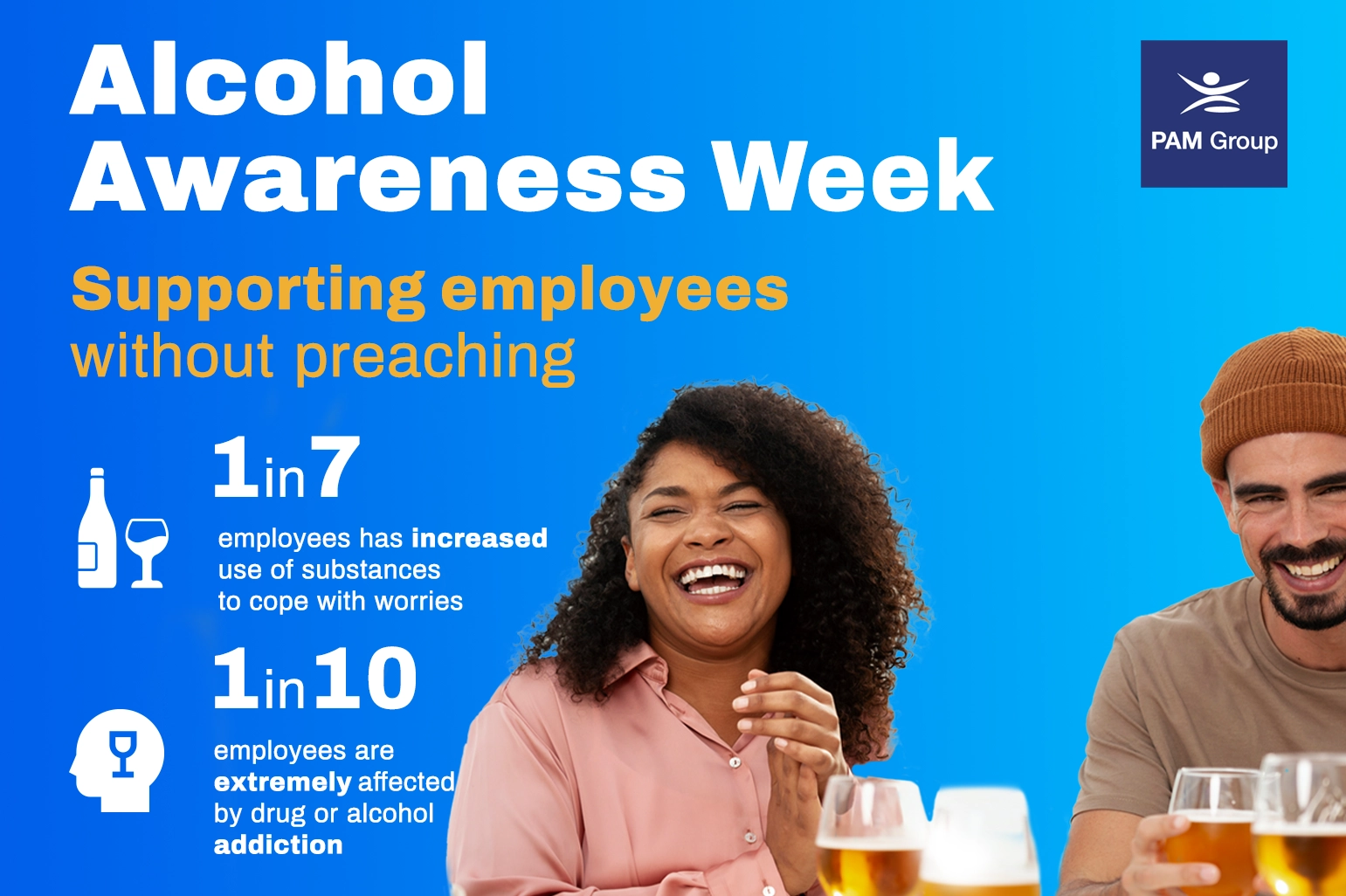

Alcohol Awareness Week: Supporting employees without preaching
As summer socialising and major sporting events drive up alcohol consumption, Alcohol Awareness Week creates an opportunity for supportive conversations.
Not everyone experiencing problems with alcohol is constantly reaching for a drink. People who find themselves regularly binge drinking or relying on alcohol to decompress after work, may also be experiencing adverse effects on their sleep, mood and attendance at work.
Interestingly, this year’s Alcohol Awareness Week (6-12 July) isn’t about telling people what they should or shouldn’t be doing. Instead, the theme, “Alcohol and Me”, encourages everyone to check in, reflect and take stock of the role alcohol plays in their lives.
So how can employers support this conversation and help employees better understand the impact alcohol can have on wellbeing and mental health, without being seen to preach?
Five ways to help employees better understand the impact of alcohol
1. Understanding the impact on wellbeing
Lots of people understand the physical after-effects of alcohol, which can include nausea, headaches, impaired decision making, sleeplessness, increased risk taking and aggression. Fewer people understand the extent to which alcohol is a depressant that can depress the central nervous system, increasing anxiety and depression. This can also have a knock-on effect on their relationships and productivity.
Only by exploring their own relationship with alcohol and reflecting on how this is making them feel can they understand the impact on them. This also includes one-off episodes of binge drinking at social events, which can still have damaging impacts. With unhealthy levels of alcohol shown to increase the risk of heart disease, liver disease and even cancer.
It’s also important for employees to reflect on how their relationship with alcohol may have changed over time. Our ability to party all night and recover reduces as we get older, meaning we are not able to bounce back in the same way as we could in our 20s.
2. Reflecting to decide what to prioritise
It’s not an employer’s job to tell people how much they can drink, so long as this isn’t making them unsafe at work. Most people tend to do the opposite of what they’re being told to do anyway. Instead, it’s important to approach this from the perspective of awareness.
Are they aware what impact alcohol is having on them? What is it giving them and what is it taking away? If it’s a way of relaxing and socialising, are there healthier ways to do that? In Ireland, for example, the sauna is reported to be the new pub, as individuals swap barstools for wild swimming and hot benches as a more invigorating way to socialise.
Although not everyone has the opportunity to escape into the Atlantic Ocean, instead of a glass of Guinness, what rituals is drinking associated with? Do they need or want to drink at every social event or sporting fixture? How well is alcohol serving its former purpose? Is there a healthier and more enjoyable way to achieve the same goal?
3. Taking stock and setting goals to move forward
Critical to helping employees understand their relationship with alcohol is helping them to take stock. Just as someone might think they’re eating healthily, only to realise they’re not once they start writing everything down, an alcohol stock-take might also be required.
With the cost of living encouraging more people to drink at home, it can be particularly easy to lose track of how much alcohol is being consumed by topping up from an open bottle of wine or spirits.
Encourage employees keen to change to take stock of how much they’re actually drinking so they can make an informed decision about how much they actually want to drink and put in place a plan to achieve this.
4. Encourage healthy conversations around alcohol
Instead of employees struggling to make changes in isolation, it can be helpful for them to hear positive stories from others, especially role-models, such as a manager or business leader, who “just didn’t want to lose that many weekends to hangovers anymore.”
The more normalised these conversations become, the less stigmatised the idea of reducing alcohol intake will become and the more likely employees are to become aware of and rethink their relationship with alcohol.
Did someone decide to be a nominated driver to justify not drinking in pubs to others? What alcohol free drinks would they recommend? What happened when they decided to totally quit and struggled? How did they set a more achievable goal to keep moving forward?
5. Support those who are struggling
For individuals already experiencing alcohol addiction, changing their approach to alcohol will require more than insight and will-power. By having a clear drug and alcohol policy you can make it easier for employees to find the support services in place.
Make sure this is clearly displayed on your intranet and managers made aware of the support in place. If a manager notices someone repeatedly missing Mondays, coming in smelling of alcohol or looking dishevelled, they need to have a compassionate wellbeing conversation.
This isn’t about accusing the employee of being an alcoholic. It is about taking them to one side to factually observe consistent patterns that are emerging. For example, “You’re coming in very late on a Monday, you’re not your usual self and your performance isn’t where it usually is. Are you okay?”
Sometimes individuals sliding into problematic drinking can benefit enormously from someone else observing there is a problem to help them recognise this in themselves. These conversations require courage on the part of the manager, so it can be useful to remind them that they too can call the EAP for coaching on how to hold that type of conversation, including how best to open up the discussion, the best questions to ask and how to respond.
If the company has occupational health services in place, managers can also use this to hold a ‘case conference’ to get insights on how to best support the employee, including how to raise a manager referral and put in place any reasonable adjustments to support the individual’s recovery. This can also include help to tackle the underlying reasons driving the problem, such as using alcohol as a way of supressing feelings, unresolved trauma or managing pain.
Kathy Cox is a wellbeing consultant for PAM Group
How can PAM Group help?
Alcohol Webinars and Workshops – to educate and inspire employees to reflect on their relationship with alcohol and make informed choices about how to improve wellbeing
Employee Assistance Programme (EAP) – to provide individuals with alcohol and wellbeing support and managers with the opportunity to role-play having wellbeing conversations
Occupational Health Manager Referral Programme – for managers to refer individuals who might be struggling with addiction into for professional support and signposting
Courageous Conversation Training – training to help managers identify when employees might be struggling and use a framework for opening up supportive conversations
Case Management – for managers to be guided through managing an employee struggling with alcohol, from how to talk to them to best ways to signpost into recovery services
For more information about how we can support your organisation, please contact us to arrange for one of our wellbeing consultants to provide you with a no-obligation consultation.
Recent Insights
Men’s Health Week: How to move from awareness to action
When Trauma Comes to Work: What Employers Need to Know
Five ways to stop sedentary work harming employee health
Occupational health insights on keeping your people healthy and productive
Want to have our latest research, case studies and opinions
delivered straight to your inbox?